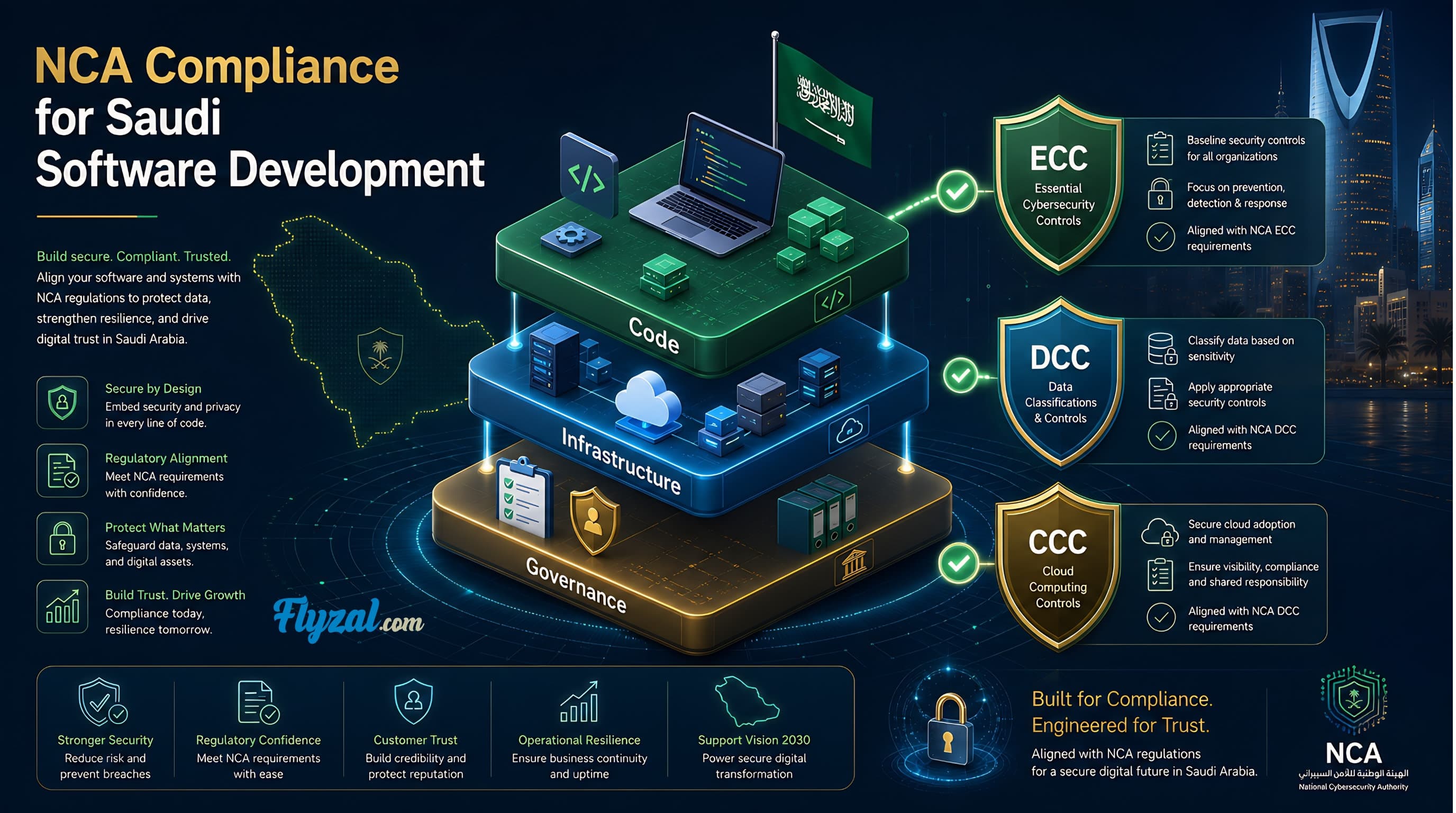
Navigating the Security Wall in Riyadh
Security mandates from the National Cybersecurity Authority (NCA) often feel like a wall for fast-moving dev teams in Riyadh. Government contracts in the Kingdom frequently arrive with security annexes that require data to stay strictly within national borders. If you're building tools for a ministry or a PIF-backed entity, you need a realistic plan for NCA compliance for Saudi software development that doesn't involve manual file transfers or slow-motion deployments. I've watched engineering leads stall for months because they treated security as a final audit instead of a core architectural requirement. The cost of being wrong is high, ranging from project termination to heavy fines under the Personal Data Protection Law (PDPL), now enforced by SDAIA.
Building for the Saudi market means accepting that your favorite global cloud tools might not be available. When you handle sensitive government data or personal data of Saudi residents, a standard GitHub Actions runner hosted in the US or Europe is a compliance violation under PDPL's data residency requirements. The NCA is strict about cybersecurity controls, and SDAIA is strict about data residency. You must ensure your CI/CD pipelines, log storage, and even temporary build artifacts reside on Saudi soil. This usually means configuring self-hosted runners within Google Cloud Dammam (me-central2 region) or Oracle Cloud's Saudi Arabia regions. It's more work than a standard setup, but it's the only way to pass rigorous security clearance and maintain PDPL compliance.
Practical NCA Compliance for Saudi Software Development Pipelines
Meeting the Essential Cybersecurity Controls (originally ECC-1:2018, updated to ECC 2-2024 in April 2024) is the baseline requirement for government agencies, critical infrastructure operators, and increasingly for private sector contractors working with sensitive data. You can't just claim to be secure — you have to prove it through continuous monitoring, documented access controls, and adherence to the framework's 114 controls across governance, asset management, access control, operations, and cyber defense domains.
Here are the specific areas where I see most builders fail:
1. Identity and Access Management
You must enforce multi-factor authentication (MFA) for every developer and service account. Using national identity providers and integration with government platforms is often required for user-facing applications serving Saudi government entities.
2. Data Encryption at Rest
It sounds basic, but NCA expects you to manage your own encryption keys. Using default provider-managed keys often won't satisfy deep-dive audits. Implement customer-managed encryption keys (CMEK) or bring-your-own-key (BYOK) solutions that give you control over key rotation, access policies, and audit trails.
3. Localized Logging and Audit Trails
All audit logs must be stored locally within Saudi Arabia for extended retention periods as specified by NCA controls and sector-specific regulations. If your logs are streaming to a server in Virginia or Dublin, you're failing both ECC and PDPL requirements.
4. Data Residency Under PDPL
Hosting data inside Saudi Arabia is the default requirement, not a best practice. Cross-border transfers of personal data require:
Explicit user consent
Risk assessment of the destination country
Binding contracts with third parties
Approval from SDAIA (the competent authority for PDPL enforcement)
Even indirect data flows — backups, DR sites, logs sent to third-party SaaS tools — are in scope under PDPL.
The Reality of Implementation
There is a significant trade-off to this approach that many consultants won't tell you. Local infrastructure in the Kingdom can incur additional costs compared to standard global regions due to limited provider competition, smaller economies of scale, and the requirement to purchase through local resellers (for example, Google Cloud Dammam services must be purchased through CNTXT if you have a KSA billing address). Furthermore, some specific managed services — like certain serverless functions or specialized database instances — are not always available in local zones. You might have to build and maintain more of your own stack than you're used to. This is the reality of working in a market that prioritizes sovereignty over convenience.
The Role of Local Cloud Providers
The entry of major players like Google Cloud (Dammam region) and Oracle Cloud (Saudi Arabia regions) has changed the math. Before these local regions existed, you had to maintain physical servers in a local data center, which was a nightmare for scaling. Now, you can run containerized workloads that meet residency requirements while still using modern orchestration tools.
I recommend starting with a small, local footprint for your staging environment to catch compliance issues early. Map your workloads and data dependencies before you migrate or scale cloud services — residency controls only work when upstream dependencies (logs, backups, DR, monitoring) are known and accounted for. Waiting until the production push to find out your database isn't allowed to sync with an external API, or that your monitoring tool is sending telemetry to Europe, is an expensive mistake.
Frequently Asked Questions
Is ECC-1:2018 still the current standard?
No. The framework was updated in April 2024 to ECC 2-2024, which strengthens cybersecurity controls at the national level. Organizations should ensure they're complying with the updated version, not the 2018 baseline.
Who enforces PDPL — NCA or SDAIA?
SDAIA (Saudi Data & AI Authority) is the competent authority for PDPL enforcement, including approval of cross-border data transfers. NCA governs cybersecurity controls (ECC framework). Both authorities work together, but their mandates are distinct.
Can I use AWS for Saudi government projects?
AWS does not currently have a Saudi Arabia region. For data residency compliance, you'll need to use Google Cloud Dammam, Oracle Cloud Saudi Arabia, or local data centers.
Do I need a Data Protection Officer (DPO)?
DPO appointment is mandatory for organizations whose core activities involve large-scale processing of sensitive personal data, large-scale systematic monitoring, or as determined by SDAIA based on risk assessment. Even when not mandatory, appointing a DPO is considered best practice and demonstrates commitment to compliance.
I build free and paid tools at flyzal.com that put these ideas into practice. Access requires an account, with fast sign-in via Google or GitHub. I also work with companies that want these concepts turned into production-ready software for their teams.