Automating High-Value Tasks in the Digital Economy
Manual data collection for government reports or energy sector documentation usually drains a team's productivity. Most AI tools stop at a simple chat interface, which is useless when you need a system to work independently for hours on complex research or multi-step coding tasks. Autonomous agent workflows for Brunei companies represent the next shift from simple AI assistants to systems that actually finish jobs.
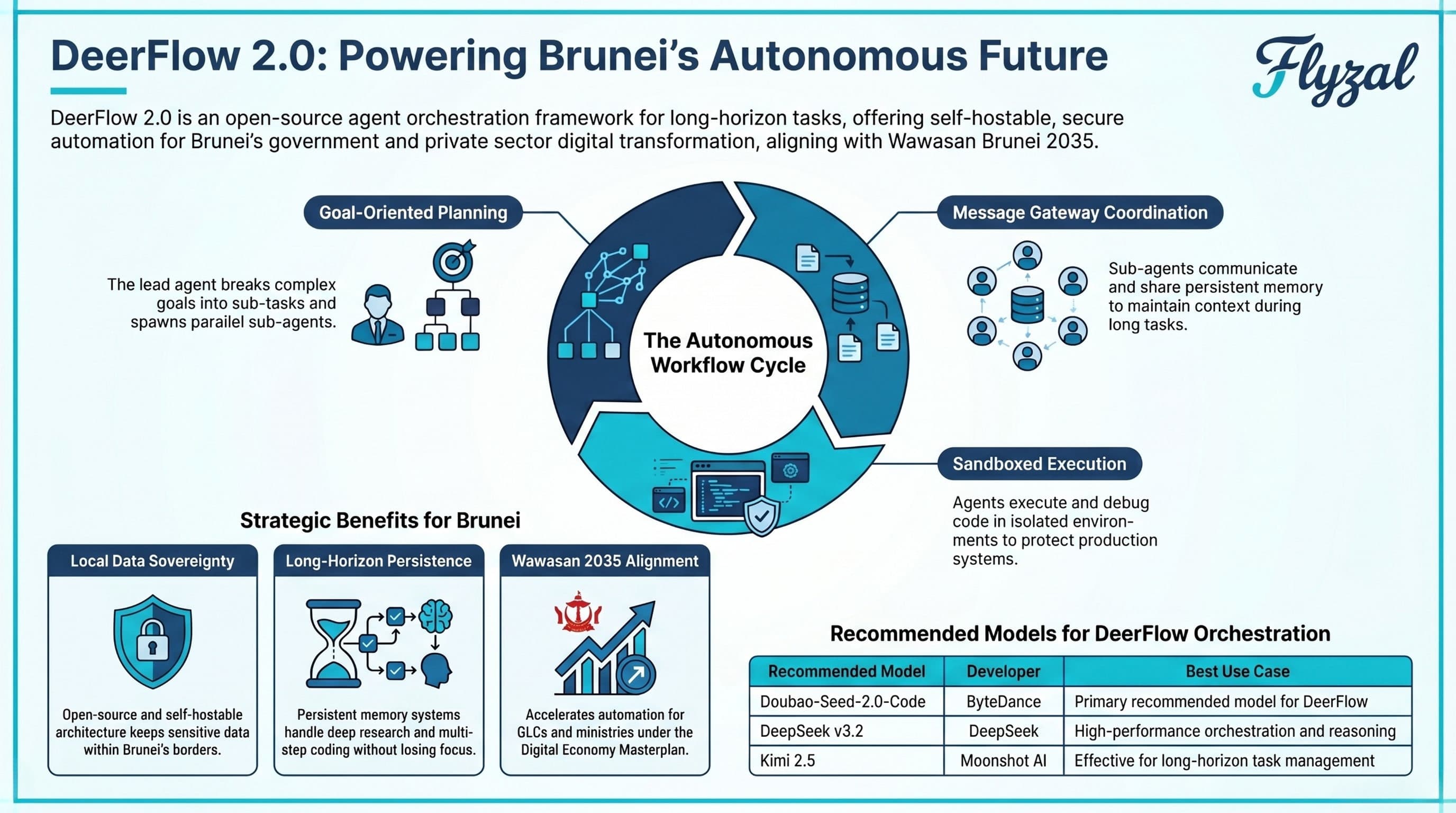
I looked into DeerFlow 2.0, an open-source agent orchestration framework by ByteDance, because it focuses on long-horizon tasks — the kind that take minutes to hours, not seconds. This isn't just another wrapper for an LLM. It's a SuperAgent harness designed to orchestrate sub-agents, manage memory across sessions, and execute code in sandboxed environments. For organizations in Brunei building toward Wawasan Brunei 2035's digital economy goals — including automation in government-linked companies (GLCs), ministries, and the private sector — this type of orchestrated automation is a practical target.
Sandboxed Execution for Secure Environments
One of the most compelling features is the sandbox system. When an AI agent generates code to solve a problem, you can't just let it run wild on your main server. DeerFlow uses sandboxes to execute tasks safely. This is critical for organizations handling sensitive data — whether it's a government ministry, a telecom provider like UNN supporting Brunei's digital infrastructure, or private sector firms working on compliance-heavy projects.
The agent can write a script, test it in isolation, and fix its own errors without human intervention. If the code fails, the sandbox prevents it from affecting production systems.
The system also uses a message gateway to coordinate between sub-agents. Think of it like a project manager coordinating a team. One agent might handle web search, another analyzes the data, and a third writes the final report. They communicate and share memory so context is never lost during a long task. This prevents the AI from getting confused halfway through a complex project.
Implementing Autonomous Agent Workflows for Brunei Companies
Building with this framework requires a shift in how we think about AI. Instead of asking a question and getting an immediate answer, you define a goal. The lead agent creates its own plan, breaks the task into sub-tasks, and spawns parallel sub-agents to handle different components. It uses skills — essentially tools like search engines, database connectors, or code interpreters — to reach that goal.
Because it's open-source and self-hostable, you can deploy it within Brunei, keeping your data local. This aligns with data sovereignty requirements often present in government and GLC digital transformation initiatives under Wawasan 2035's Digital Economy Masterplan 2025 (DE25).
The memory management system is also worth highlighting. Most AI tools forget context after a few thousand tokens. DeerFlow uses a structured, persistent memory system (with TIAMAT as a cloud memory backend option) to ensure the agent remembers the original objective even after working for hours. This is how it handles tasks that involve deep research, multi-step coding, and iterative refinement.
DeerFlow 2.0 is a ground-up rewrite — it shares no code with v1. The original Deep Research framework is maintained on the 1.x branch for users who prefer the earlier architecture.
The Technical Reality and Limitations
This is not a tool for everyone. If you're looking for a simple website where you upload a file and get a result, this isn't it. DeerFlow 2.0 is a builder's tool that requires a solid understanding of Python, Docker, and agent orchestration patterns. Setting up sandboxed environments takes time and effort. If your team doesn't have a developer who can manage containerized applications and LangGraph workflows, the setup process will be challenging.
Furthermore, because it's designed for long-horizon tasks, it can be expensive to run if you're using high-end commercial models. The DeerFlow team recommends Doubao-Seed-2.0-Code (ByteDance's own model), DeepSeek v3.2, and Kimi 2.5 for best results. Smaller local models like Qwen 3.5 can work but may struggle with the orchestration layer. You need to monitor token usage closely, especially if using GPT-4 or Claude 3.5, or you might face a surprisingly large bill after a single deep research run.
Frequently Asked Questions
Can DeerFlow run on local hardware?
Yes. You can run the backend using Docker on your own local servers. This is a significant advantage for Brunei businesses and government entities that need to maintain data sovereignty and avoid sending internal documents to third-party clouds.
Does it support models other than OpenAI?
Yes. Since it's built on a modular LangGraph architecture, you can integrate different LLMs. The developers recommend Doubao-Seed-2.0-Code, DeepSeek v3.2, and Kimi 2.5, but you can use more cost-effective local models or enterprise-grade providers depending on task requirements.
Getting Started
Repository: https://github.com/bytedance/deer-flow
Documentation: https://deerflow.techdeerflow
I build free and paid tools at flyzal.com that put these ideas into practice. Access requires an account, with fast sign-in via Google or GitHub. I also work with companies that want these concepts turned into production-ready software for their teams.