The Problem With 'Stiff' Arabic AI Outputs
Arabic AI models have improved significantly, but the distance between a grammatically correct sentence and a compliant, culturally grounded tender proposal is still wide. Most international contractors assume that a quick machine translation is enough, but optimizing Arabic AI outputs for Saudi tenders requires local context, regulatory precision, and human verification that standard LLMs can't provide alone.
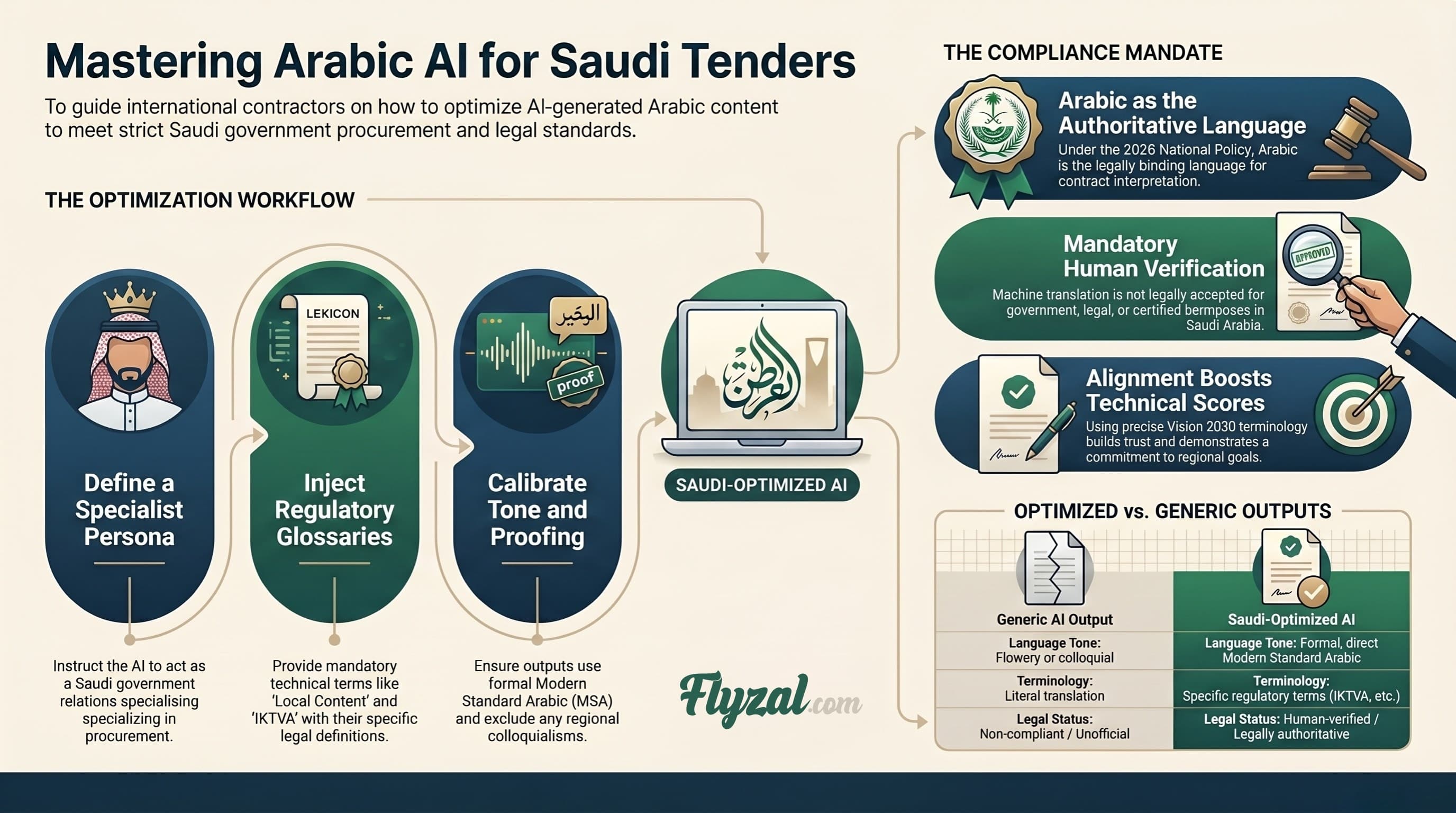
In Riyadh or at NEOM procurement offices, proposals must meet Saudi government standards — and those standards are now stricter than ever. The National Policy for the Arabic Language, approved by the Council of Ministers in February 2026, mandates Arabic as the official language across government entities, private sector contracts, invoices, and official correspondence. For government tenders specifically, Arabic is the legally authoritative language for contract interpretation and execution. A proposal that reads like a direct translation of a Silicon Valley pitch deck will fail both the compliance check and the technical evaluation.
I see too many firms using raw GPT-4 or Claude outputs for their bid responses without adapting them to the formal Modern Standard Arabic (MSA) expected by the Ministry of Investment, the Public Investment Fund (PIF), and Vision 2030 project authorities. These entities expect authoritative yet respectful prose that aligns with the strategic language of Vision 2030 and Saudi regulatory frameworks. The tone must reflect an understanding of local business etiquette and administrative language, not just grammatical correctness.
Practical Steps for Optimizing Arabic AI Outputs for Saudi Tenders
To produce usable results, you must move beyond simple prompting. AI should be treated as a draft generator, not a final author, with mandatory human review by a native-speaking subject matter expert. Here's the workflow I recommend for contractors and consultants working on Saudi mega-projects:
Define the Persona: Don't just ask for a translation. Instruct the model to act as a Saudi government relations consultant who specializes in procurement protocols and Vision 2030 alignment.
Glossary Injection: Provide the model with a list of mandatory technical terms with their specific regulatory definitions in Arabic. For example, ensure terms like Local Content (المحتوى المحلي) and IKTVA are handled precisely as defined in Saudi procurement law.
Tone Calibration: Explicitly ask the model to avoid flowery or overly casual language and stick to the formal, direct prose typical of Saudi government communications and the National Policy for Arabic Language standards.
Regional Proofing: Check for Levantine or Egyptian colloquialisms that often creep into generic Arabic LLMs. The output must remain in pure, professional MSA as used in Saudi official contexts.
Human Verification: Have a qualified Arabic translator or Saudi procurement specialist review the final draft. Machine translation is not accepted for legal, governmental, or certified purposes in Saudi Arabia — only human-verified translation meets the standards required by Saudi courts and government bodies.
A genuine limitation you must accept is that AI still cannot perfectly capture the nuance of Saudi administrative law or current policy priorities. It can draft the bulk of your response, but it lacks the situational awareness to know which specific local regulations are currently being emphasized by a particular ministry. AI is a tool for speed, not a replacement for local expertise.
Why Arabic Localization Impacts Your Technical Score
Evaluators at entities like Red Sea Global, Qiddiya, and NEOM are looking for more than just technical specs — they're looking for alignment with the Kingdom's goals and compliance with the National Policy for the Arabic Language. When your documentation uses the correct terminology for sustainability, digital infrastructure, or local content as defined by Saudi standards, you build trust and demonstrate operational attention to detail.
Generic AI output often misses these specific linguistic markers. By refining the output with human oversight and regional expertise, you demonstrate that your business is not just "dropping in" for a contract, but is invested in the regional ecosystem and committed to Saudi regulatory compliance. Accuracy in your Arabic documentation is a direct reflection of your commitment to the Kingdom's Vision 2030 objectives.
I build free and paid tools at flyzal.com that put these ideas into practice. Access requires an account, with fast sign-in via Google or GitHub. I also work with companies that want these concepts turned into production-ready software for their teams.