Scaling Content Across the Kingdom
Managing high-traffic web portals in Saudi Arabia requires more than just translating text into Arabic. Most teams start with a standard monolithic CMS and quickly hit a wall when trying to manage Right-to-Left (RTL) layouts alongside English mirrors. I've watched developers spend more time fixing CSS float issues for Arabic headers than actually building new features. Switching to a headless CMS for Saudi multi-language websites is often the only way to escape this cycle while maintaining the web performance standards expected in the Kingdom.
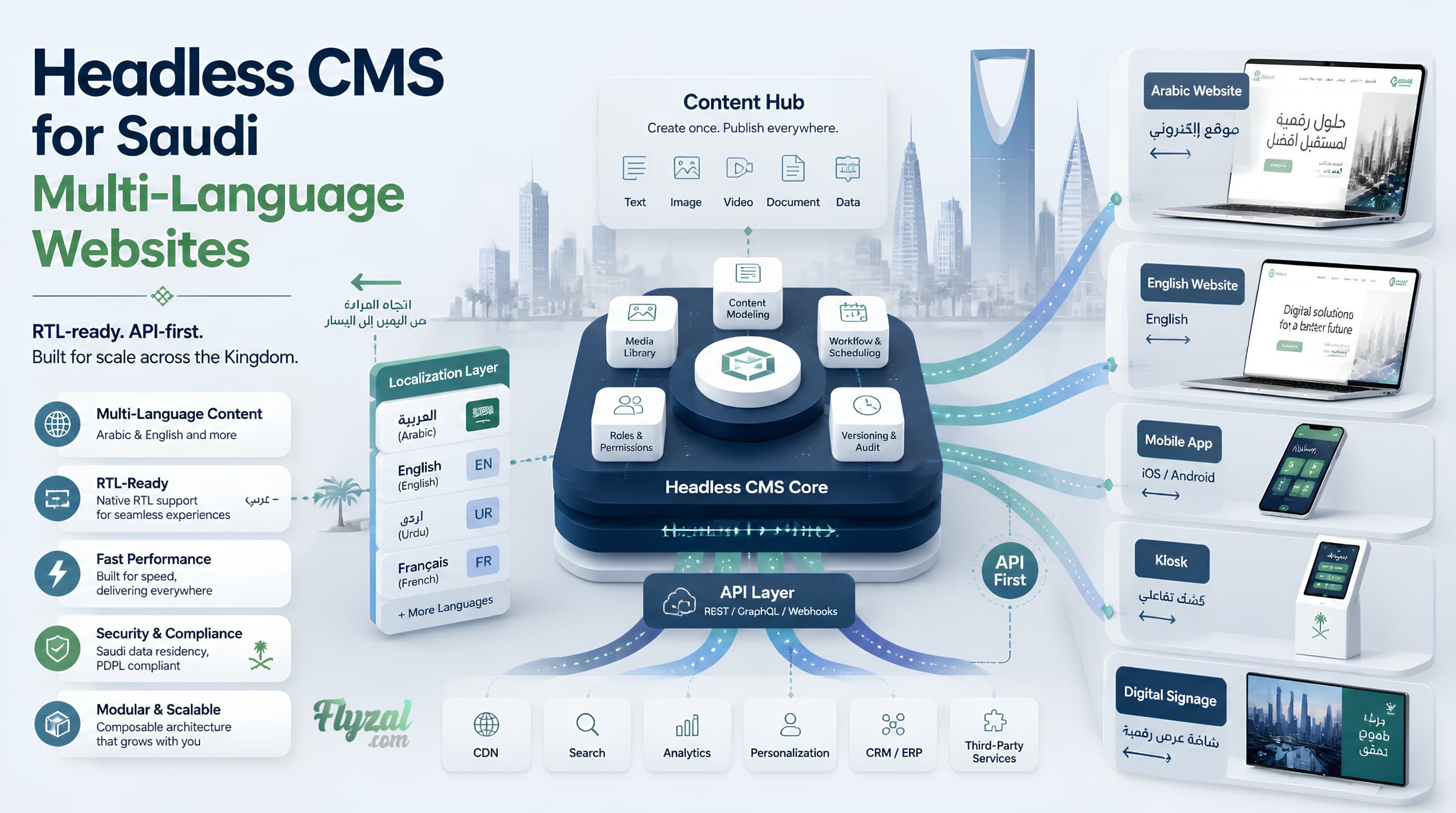
When you decouple your content from your presentation layer, you gain total control over the RTL experience. You're not fighting a theme's pre-coded logic. Instead, you serve clean JSON to a front-end framework like Next.js or React, allowing you to flip the layout based on the locale. This matters for Saudi enterprises where the digital experience must feel native, not like a translated afterthought.
Why Headless CMS for Saudi Multi-Language Websites Wins
Traditional systems often bundle the database, the admin panel, and the front-end into one package. This creates a bottleneck for Saudi-based builders who need flexibility in how and where they deploy content. A headless architecture lets you store your content in a centralized hub and push it to any platform — mobile apps, web portals, kiosks in smart cities like NEOM, or even voice interfaces.
Key advantages:
Total layout control for perfect RTL typography and alignment without CSS hacks
Faster deployment of localized marketing campaigns for Riyadh Season, Saudi National Day, or Vision 2030 events across web, mobile, and digital signage simultaneously
Improved security by decoupling the administrative backend from the public-facing site
Easier integration with local Saudi payment gateways (Mada, STC Pay, Tabby) and shipping APIs without CMS-specific limitations
Better Core Web Vitals — API-first delivery enables LCP < 2.5s and INP < 200ms, which are Google ranking factors and how Saudi government sites are benchmarked
The Saudi Arabia web performance market is growing 9.6% annually and expected to reach $235.6 million by 2030, driven by increasing expectations for mobile-first, fast-loading bilingual experiences.
Recommended Headless CMS Platforms for Arabic/RTL
Based on production deployments for Arabic-English bilingual content, these platforms handle RTL well:
PlatformStrengthsBest ForSanityStrong multilingual support, flexible content modeling, RTL-friendly editorEditorial teams, content-heavy sitesStrapiOpen-source, self-hostable, Arabic/RTL support, customizableDevelopers who need full control, budget-conscious projectsContentfulEnterprise-grade, robust API, translation workflow integrationsLarge organizations, global brandsPayload CMSTypeScript, self-hosted, powerful localization, modern admin UITech-forward teams, custom workflowsStoryblokVisual editor, real-time preview, multilingual out-of-boxMarketing teams, rapid content iteration
All support integration with translation platforms like Lokalise, Crowdin, or Phrase for professional Arabic translation workflows.
Managing Regional Specifics
Localized content goes beyond language. You have to account for regional nuances:
Date formats — Hijri calendar alongside Gregorian
Currency — SAR (﷼) with proper Arabic numeral rendering
Cultural imagery that aligns with local expectations and Saudi content regulations
RTL UI patterns — right-aligned navigation, mirrored layouts, proper Arabic typography with diacritics
A headless approach allows your content editors to focus on the message in the CMS while the front-end handles the technical specifics of displaying those formats correctly for users in Jeddah versus those in Dammam.
I use this method for projects where speed is non-negotiable. Saudi users have high expectations for mobile performance, and traditional systems struggle to deliver Core Web Vitals-compliant experiences when bloated with localization plugins. By moving to an API-first model, you trim the fat. You deliver only the data needed for the specific page, which is a massive advantage for SEO in competitive local markets.
Data Residency and Compliance
For websites handling personal data of Saudi residents, PDPL requires data to be stored within Saudi Arabia or transferred with explicit consent and SDAIA-approved safeguards. A headless CMS architecture makes this easier because:
You can self-host the CMS backend in Saudi cloud regions (Google Cloud Dammam, Oracle Saudi, Alibaba Cloud)
You can use managed headless CMS providers with data residency controls
You decouple content storage from delivery, giving you flexibility to meet residency requirements without sacrificing performance
CST's "Regulations of Accessing Locally Hosted Internet Content" (effective Nov 2023) aims to improve access to locally hosted content, though it primarily applies to facilities-based telecom providers rather than mandating all websites be hosted locally.
The Reality of Implementation
One major trade-off exists that many people ignore. Building a headless setup is significantly more expensive and complex than a standard one-click WordPress install. If you're a solo founder launching a small landing page, this is overkill. You will need a dedicated developer or a specialized agency to wire everything together. It's not a no-code dream; it's a structural choice for teams planning to scale across multiple channels and languages.
When headless makes sense:
High-traffic government or enterprise portals
Multi-channel content (web + mobile app + kiosks)
Frequent bilingual content updates (news, e-commerce, events)
Teams with developer capacity
When traditional CMS is fine:
Small business websites
Simple blogs
Limited budget and no developer resources
Infrequent content updates
Frequently Asked Questions
Do I need to host my website in Saudi Arabia?
Not necessarily. PDPL requires personal data of Saudi residents to be stored in KSA or transferred with approved safeguards. CST's local hosting regulations primarily apply to licensed telecom providers, not all websites. However, local hosting can improve performance for Saudi users.
Which headless CMS is best for Arabic content?
Sanity, Strapi, and Contentful are the most popular for Arabic-English bilingual content. Strapi is best for self-hosting and budget control; Sanity for editorial flexibility; Contentful for enterprise scale.
How do I implement RTL layouts with a headless CMS?
The CMS stores content with language/locale metadata. Your front-end framework (Next.js, Nuxt.js, React) detects the locale and applies RTL CSS classes or uses CSS logical properties (inline-start, inline-end) that automatically flip for RTL.
What are Core Web Vitals and why do they matter in Saudi Arabia?
Core Web Vitals are Google's performance metrics: LCP (loading), INP (interactivity), CLS (visual stability). Saudi government ministries are ranked on website performance efficiency, and these metrics directly impact SEO and user experience in the Kingdom's growing digital economy.
I build free and paid tools at flyzal.com that put these ideas into practice. Access requires an account, with fast sign-in via Google or GitHub. I also work with companies that want these concepts turned into production-ready software for their teams.