Capturing Local Search in the Kingdom
Riyadh's King Abdullah Financial District is currently the epicenter of a massive shift in how people manage their money. Every month, a new digital wallet or "Buy Now, Pay Later" (BNPL) service hits the App Store, competing for a share of the Saudi consumer's attention. However, simply appearing in search results is no longer the metric of success. Winning in this market requires optimizing localized search intent for Saudi fintech startups to ensure your product meets the user at their specific moment of need.
Users in the Kingdom don't search like users in London or New York. Search intent here is deeply tied to Islamic finance principles, regional payment habits, and cultural financial cycles like Ramadan savings or Hajj planning. If your SEO strategy only targets formal keywords like "consumer credit" without accounting for terms like "Sharia-compliant investment" or "Mada card compatibility," you're missing the cultural and regulatory context that drives decision-making in Saudi Arabia.
The Technicality of Financial Arabic
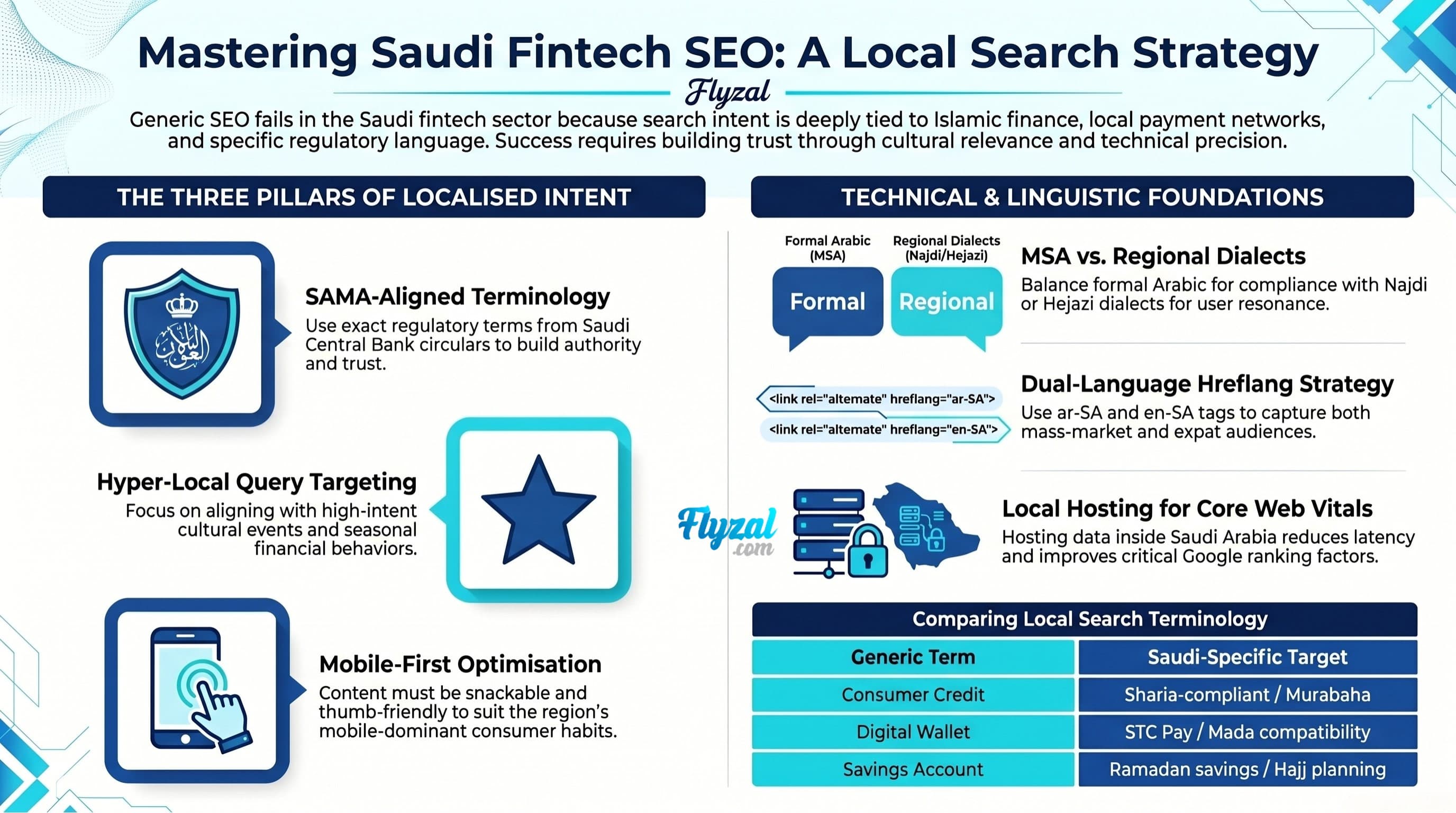
Language in Saudi Arabia is a spectrum. On one end, you have the formal Modern Standard Arabic (MSA) required for compliance with the Saudi Central Bank (SAMA) and regulatory disclosures. On the other, you have the informal Najdi or Hejazi dialects used in daily life and mobile searches. This creates a unique challenge for fintech builders.
Fintech founders often make the mistake of hiring generalist copywriters from other Arab regions. This leads to content that feels "off" to a local user. For example, the term for "savings account" or "investment" might be technically correct in MSA, but it won't resonate if the phrasing doesn't align with how Saudis actually talk about money—whether referencing Mada (the national payment network), STC Pay, or specific Islamic finance terms like murabaha or takaful that carry heavy weight here. Precision in language is the difference between a bounce and a conversion.
Optimizing Localized Search Intent for Saudi Fintech Startups
Visibility is cheap; relevance is expensive. When optimizing localized search intent for Saudi fintech startups, you're solving for trust. In a sector where users authenticate via Nafath (Saudi Arabia's national digital identity platform) and connect their bank accounts, the smallest linguistic error or cultural misalignment can look like a security risk. To capture this intent effectively, consider these three pillars:
SAMA-Aligned Terminology: Ensure your marketing copy aligns with the regulatory language used in SAMA circulars and disclosures. Use the exact terms recognized by Saudi regulators to build authority while remaining readable. This creates consistency between your marketing, compliance documents, and user expectations.
Hyper-Local Queries: Target phrases like "how to transfer money to STC Pay," "best Mada card for students," or "halal investment apps in Saudi Arabia." These show high intent and lower competition than broad terms. Include searches tied to cultural financial moments like "Ramadan savings plans" or "Hajj fund management."
Mobile-First Content: In the GCC, consumer fintech is mobile-dominant. Your content needs to be snackable, load instantly on local 5G networks, and be optimized for thumb-friendly navigation to avoid abandonment.
A Hard Truth About Local Search
There's a significant hurdle you'll face: Arabic content online skews heavily toward Egyptian and Levantine dialects, which means generic Arabic AI models and even Google's language models may not perfectly capture Saudi-specific commercial terminology and regional search patterns. This isn't an algorithmic failure—it's a training data distribution problem. If you automate your SEO without a native Saudi editor who understands local banking habits, payment methods, and Islamic finance terminology, you risk sounding like a machine—which is the fastest way to lose the trust of a potential customer in Riyadh or Jeddah. Manual review of your high-intent pages is mandatory.
Frequently Asked Questions
Should I prioritize English or Arabic for my Saudi fintech site?
Both. While Arabic is essential for the mass market and trust-building, the corporate and expat population in KSA often searches in English. A dual-language approach with proper hreflang tags (ar-SA for Arabic - Saudi Arabia, en-SA for English - Saudi Arabia) is the only way to cover the full market and signal regional targeting to Google.
Does hosting data inside Saudi Arabia affect SEO?
Directly, no—server location isn't a ranking factor. Indirectly, yes. Local hosting reduces latency for users in the Kingdom, which improves Core Web Vitals (Largest Contentful Paint, Interaction to Next Paint)—confirmed ranking factors for Google. Faster sites rank better and convert better.
I build free and paid tools at flyzal.com that put these ideas into practice. Access requires an account, with fast sign-in via Google or GitHub. I also work with companies that want these concepts turned into production-ready software for their teams.