Building a Web Platform for Saudi High-Traffic Scenarios
Building a web platform for a major public project in Riyadh means preparing for traffic spikes that would crush typical server setups. I learned this the hard way when assisting a local real estate portal during a major project announcement where concurrent users jumped tenfold in minutes. To handle this without astronomical cloud bills, you need a hosting architecture that respects regional data residency requirements and delivers low latency to Saudi users.
Let's talk about the realities of hosting high-traffic Next.js sites in Saudi Arabia instead of relying on default Western hosting platforms.
The Infrastructure Blueprint for Hosting High-Traffic Next.js Sites in Saudi Arabia
Most generic advice suggests spinning up a quick Vercel or Netlify project. But when your platform must comply with PDPL data residency requirements for personal data or NDMO standards for government data, shipping code and user data to US or EU servers creates compliance risks. You need infrastructure configured within regional borders.
When you need Saudi-based infrastructure:
Handling personal data of Saudi residents (PDPL compliance)
Government or public sector projects (NDMO standards, CCSPRs)
Critical National Infrastructure (CST Software Escrow Guideline)
Projects requiring sub-100ms latency for Saudi users
Available Saudi cloud providers (as of May 2026):
STC Cloud / SCCC — Saudi Arabia's largest cloud provider, 99.99% uptime, localized in KSA
Oracle Cloud (via stc partnership) — sovereign cloud services in Saudi Arabia
Google Cloud Dammam (
me-central2) — Saudi regionAlibaba Cloud Saudi Arabia — Saudi region
AWS Middle East — UAE (
me-central-1) and Bahrain (me-south-1) regions — note that AWS does not have a Saudi Arabia region, and both ME regions suffered a major multi-day outage in March 2026
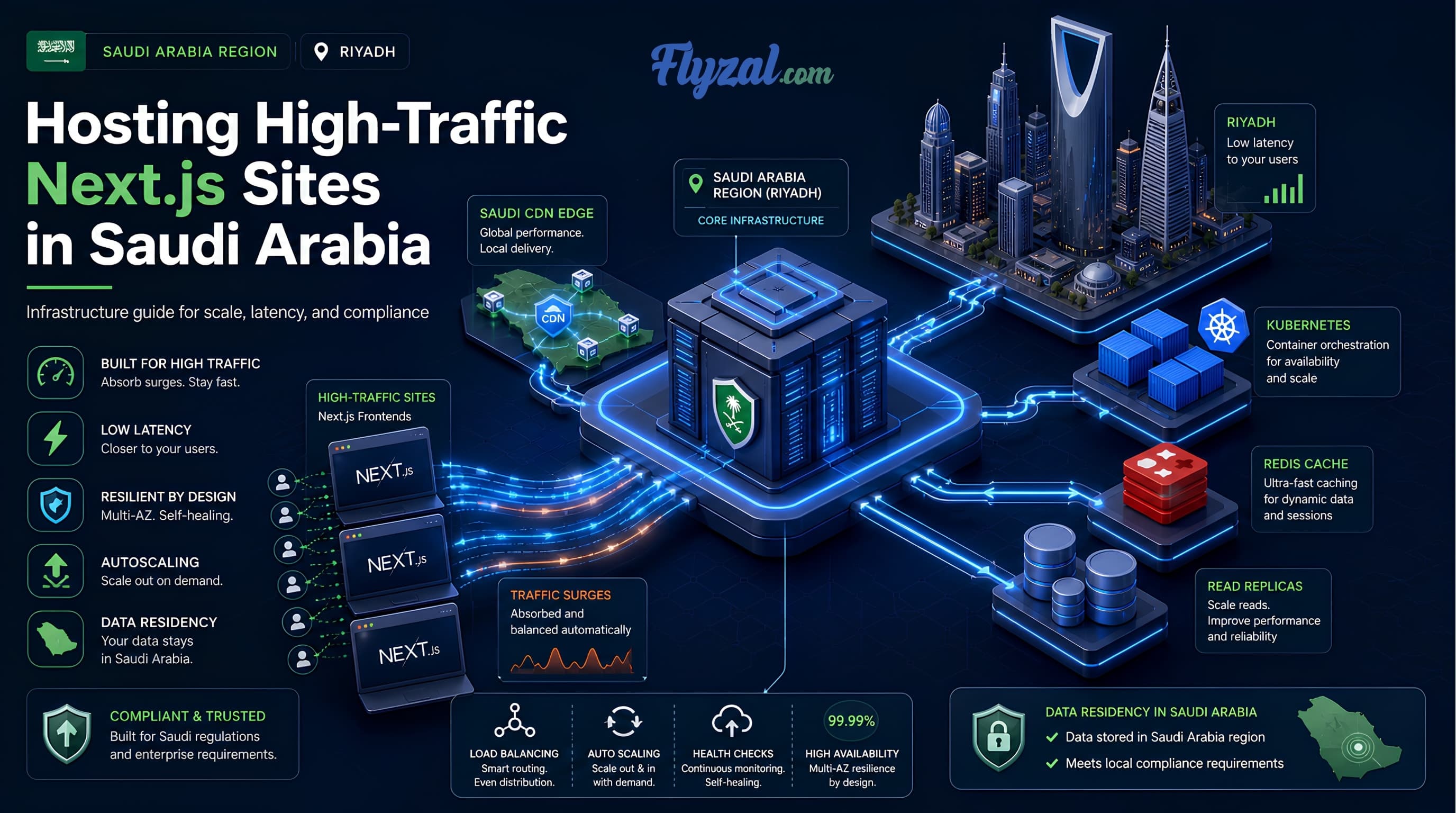
A solid stack for high-traffic Next.js sites starts with local cloud providers paired with a local Content Delivery Network (CDN) edge.
Recommended Architecture
Here's the architecture that holds up under load while maintaining compliance:
1. Local Container Deployment
Deploy your Next.js application using Docker on Managed Kubernetes (e.g., STC Cloud Kubernetes, Google Cloud GKE on Dammam) to scale pods dynamically based on traffic. This lets you handle sudden spikes during announcements, sales events, or Riyadh Season campaigns.
2. Edge Caching with Local POPs
Use CDNs with Point of Presence (POPs) in Riyadh and Jeddah to keep static assets and Incremental Static Regeneration (ISR) pages physically close to your users. Providers with Saudi POPs include:
Akamai — extensive Middle East presence
Cloudflare — Saudi POPs
STC Cloud CDN — local CDN services
This reduces Time to First Byte (TTFB) from 300-500ms (US origin) to 10-50ms (local edge).
3. Redis for Session & Cache
Avoid hitting your database on every server-side rendering request by implementing an in-memory caching layer (Redis or Memcached) inside the same Virtual Private Cloud (VPC). Cache:
Session tokens
Frequently accessed API responses
Database query results with short TTLs
User preferences and localization data
This can reduce SSR database calls by 60-80% for repeat visitors.
4. Database Read Replicas
Cross-region database queries from Riyadh to Europe can add 100-200ms round-trip latency, which compounds when SSR makes multiple database calls per page render. Setting up a read-replica database within local data centers solves read-heavy traffic pressure.
Architecture:
Write to primary cluster (can be local or regional depending on data classification)
Read from localized read-replicas for dynamic content rendering
Keep SSR page loads under 200ms by minimizing database round trips
Data Residency and Compliance
PDPL Requirements
For websites handling personal data of Saudi residents, PDPL requires data to be stored within Saudi Arabia or transferred with explicit consent and SDAIA-approved safeguards. This includes:
User accounts and profiles
Transaction history
Location data
Behavioral analytics
Government Data Requirements
Projects serving government entities must comply with:
NDMO standards — government data must remain in Saudi Arabia
CCSPRs — prohibit government-related data from leaving Saudi Arabia without explicit approval
CST Software Escrow Guideline — for Critical National Infrastructure, source code and technical materials must be escrowed within KSA
CST stores personal data within the Kingdom in compliance with these regulations.
The Real Trade-Off: Local Infrastructure Overhead
Now for the reality check: managing this yourself is not cheap or easy. Unlike the simple one-click deployments of global cloud hosts, building a compliant, high-availability cluster locally requires dedicated DevOps engineering.
What you'll manage:
Kubernetes manifests and deployment pipelines
Ingress controllers and load balancer configuration
Security patches and compliance updates aligned with NCA Essential Cybersecurity Controls
Monitoring, alerting, and incident response
Database backup and disaster recovery within Saudi borders
If you're a three-person startup with limited runway, this overhead can stall your product shipment for weeks. You must weigh the regulatory requirement of data sovereignty against your team's current technical bandwidth.
When to Use Managed Services vs. Self-Hosted
Approach | Best For | Considerations |
|---|---|---|
STC Cloud / SCCC managed services | Government projects, enterprises, teams without DevOps capacity | Higher cost, turnkey compliance, 24/7 Saudi support |
Google Cloud Dammam managed Kubernetes | Mid-size companies, tech-forward teams | Requires Google Cloud expertise, must purchase through CNTXT |
Self-hosted on STC VMs | Cost-sensitive projects, full control requirements | Highest DevOps overhead, most cost-effective at scale |
Vercel/Netlify with Saudi database | Non-government projects with limited PII | Front-end globally distributed, database local — verify PDPL implications |
Performance Benchmarks
Typical latency targets for high-traffic Saudi Next.js sites:
Metric | Target | How to Achieve |
|---|---|---|
TTFB | < 100ms | Local CDN POPs, edge caching |
SSR Database Query | < 50ms | Read replicas in same region/VPC |
Full Page Load | < 2s | Code splitting, image optimization, Redis caching |
ISR Revalidation | < 200ms | Local cache invalidation, edge regeneration |
Frequently Asked Questions
Does AWS have a Saudi Arabia region?
No. AWS's closest regions are Middle East (UAE) (me-central-1) and Middle East (Bahrain) (me-south-1). Note that both regions experienced a major outage in March 2026. For data residency compliance, use STC Cloud, Google Cloud Dammam, Oracle Cloud Saudi, or Alibaba Cloud Saudi Arabia.
Can I use Vercel for Saudi government projects?
Not if the project handles government data or PII requiring data residency. Vercel's infrastructure is globally distributed, which violates NDMO standards and PDPL requirements. You can use Vercel for the front-end if your database and user data are hosted locally, but verify compliance with legal counsel.
What's the cost difference between local and global hosting?
Local Saudi infrastructure typically costs 20-40% more than equivalent AWS US/EU regions due to smaller economies of scale and mandatory local partnerships (e.g., Google Cloud Dammam requires CNTXT reseller). Factor in additional DevOps time for self-managed setups.
How do I handle traffic spikes during major announcements?
Use Kubernetes Horizontal Pod Autoscaling to scale Next.js pods based on CPU/memory or custom metrics (requests per second). Pre-warm the cluster before known events. Implement edge caching for static content so spikes hit the CDN, not your origin servers.
I build free and paid tools at flyzal.com that put these ideas into practice. Access requires an account, with fast sign-in via Google or GitHub. I also work with companies that want these concepts turned into production-ready software for their teams.