The Trap of Standard Arabic in Saudi Retail
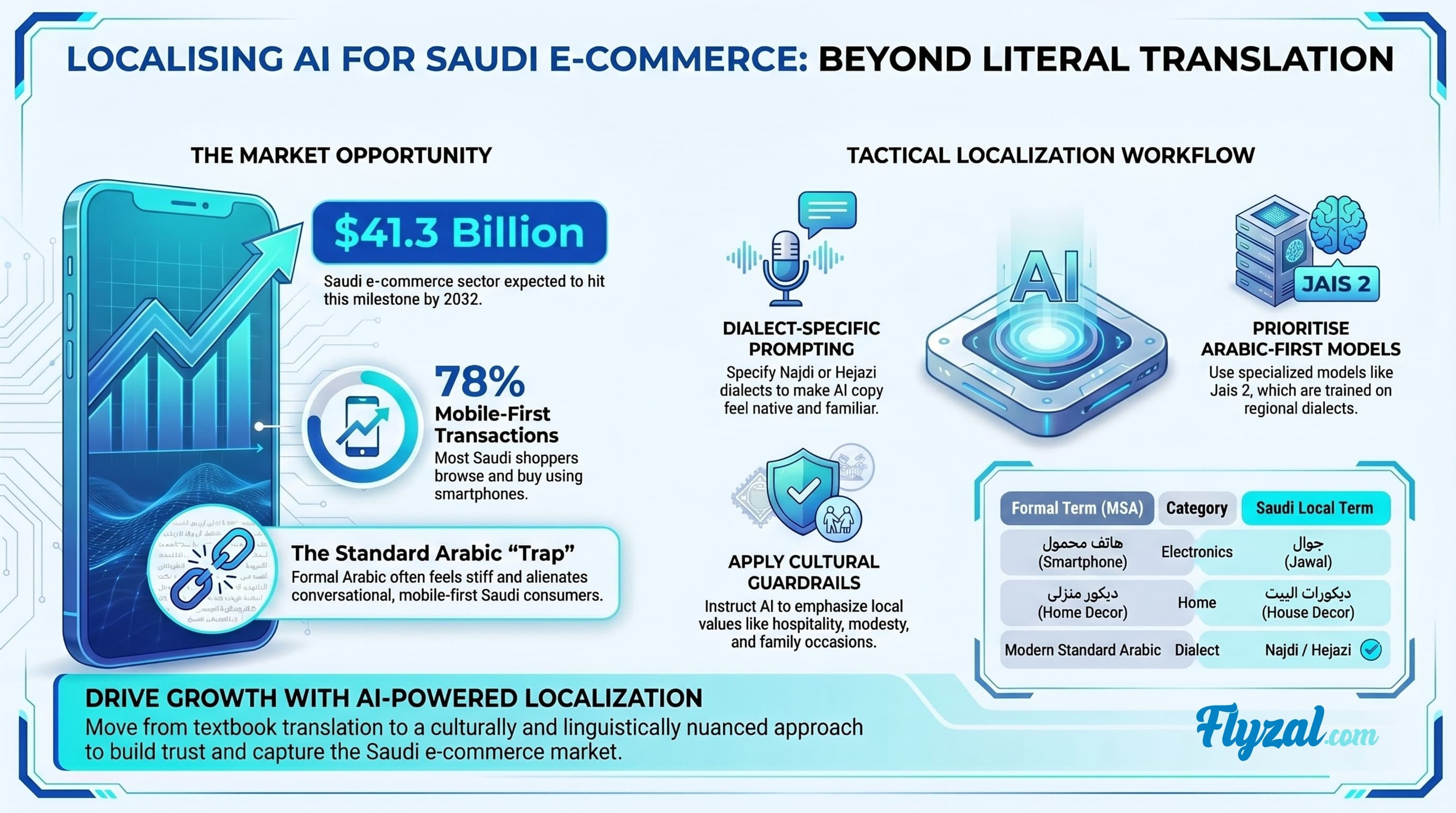
Saudi e-commerce is growing rapidly — the market reached $16.1 billion in 2024 and is forecast to hit $41.3 billion by 2032, driven by 98.6% internet penetration and 78% of transactions happening on smartphones. While Modern Standard Arabic (MSA) serves official government portals well, it often fails to connect with shoppers browsing Noon, Jarir, or Haraj on their mobile devices. I see too many retailers using generic translation tools that produce stiff, textbook Arabic. This results in high bounce rates and low trust. Localizing AI content for Saudi e-commerce growth requires moving past literal translation into cultural resonance.
The Saudi consumer is highly sophisticated and mobile-first. If your product descriptions or marketing copy sound like a translated instruction manual from 2005, you lose. Platforms like Noon and Haraj have set a standard for how Saudis expect to be addressed — conversational, culturally grounded, and regionally aware. It's about more than just changing words; it's about reflecting the values and the specific linguistic flair of the Kingdom.
Most general-purpose LLMs default to a Levantine or Egyptian Arabic bias because those dialects dominate Arabic training data online. This creates a mismatch: your AI-generated product descriptions might use Egyptian slang or Levantine phrasing that feels foreign to a Saudi shopper in Riyadh or Jeddah. Without specific intervention, your content will sound like it was written for a different market.
Tactical Steps for Localizing AI Content for Saudi E-Commerce Growth
Building a workflow that works for the KSA market involves three specific layers of refinement. You can't simply prompt an AI to "write in Arabic" and expect it to rank or sell. You need to ground the model in the local context of Vision 2030 and the specific consumer habits of the region.
1. Dialect-Specific Prompting
Instead of asking for generic Arabic, specify the Najdi (Central Saudi Arabia, including Riyadh) or Hejazi (Western Saudi Arabia, including Jeddah and Mecca) dialect for social media copy and product descriptions. This changes the "feel" of the content from formal to familiar. For example:
MSA: "هذا المنتج يوفر لك أفضل الحلول" (This product provides you the best solutions)
Saudi colloquial: "هالمنتج بيعطيك أفضل شي" (This product will give you the best thing)
The second version feels conversational and native to Saudi shoppers, even though both are grammatically correct.
2. Cultural Guardrails
Explicitly instruct your AI to avoid idioms that don't translate well culturally, and to emphasize values like hospitality (Karam), generosity, and family where appropriate. Saudi e-commerce shoppers respond to messaging that reflects local values — especially around Ramadan, Eid, and National Day.
For fashion and cosmetics (top-selling categories), ensure your AI avoids overly Western or secular references and instead highlights modesty, quality, and family occasions.
3. Local Search Intent
Use SEO tools to identify how Saudis actually search for products. For example:
Instead of "home decor" → "ديكور منزلي" or "ديكورات البيت"
Instead of "smartphone" → "جوال" (the Saudi term) rather than "هاتف محمول" (formal MSA)
Consumer electronics and fashion dominate Saudi e-commerce (27% and 20% of the market respectively), so optimizing for how Saudis search for these categories — using regional vocabulary — is critical.
4. Use Arabic-First AI Models When Possible
Models like Jais 2 (developed by MBZUAI in the UAE) are trained on 600 billion Arabic tokens covering Modern Arabic, 17 regional dialects, and Arabizi (Arabic written in Latin script). These models perform significantly better on Arabic tasks than general-purpose models that treat Arabic as a secondary language. If you're building custom AI workflows for Saudi e-commerce, consider using Arabic-first models as your base rather than relying solely on GPT-4 or Claude.
A Hard Truth About Dialect Automation
A significant limitation is the current inability of most general-purpose LLMs to differentiate between urban Najdi and rural dialects, or between Hejazi and Gulf Arabic, without heavy prompting and human oversight. If you rely on base models without a native Saudi Arabic speaker in the loop, you risk sounding like an outsider trying too hard — or worse, using regional slang incorrectly, which damages trust.
This isn't a "set and forget" marketing strategy. It requires active management and a deep understanding of local culture to ensure the AI doesn't hallucinate regional phrases or use them out of context.
The Role of Data Sovereignty
Working within the Saudi market also means respecting data residency and PDPL compliance. When you're processing customer reviews, sales data, or proprietary product catalogs to train or fine-tune your local AI models, ensure your infrastructure aligns with Saudi regulations. Localized AI isn't just about language — it's about the security and trust of the people using the technology.
Builders who prioritize local hosting (Saudi cloud regions) and Arabic-first models like Jais tend to see better long-term results than those relying solely on generic Western cloud platforms.
Why This Matters for Vision 2030
Saudi Arabia's National Transformation Program and Vision 2030 specifically prioritize e-commerce as a pillar of economic diversification. The government is actively supporting SMEs and startups in e-commerce through Monsha'at (the General Authority for Small and Medium Enterprises), which provides digital marketing tools, AI-driven analytics, and emerging tech platforms.
E-commerce brands that align their content strategy with Saudi linguistic and cultural expectations aren't just optimizing for conversion — they're positioning themselves as local-first businesses in a market that rewards cultural alignment and trust.
I build free and paid tools at flyzal.com that put these ideas into practice. Access requires an account, with fast sign-in via Google or GitHub. I also work with companies that want these concepts turned into production-ready software for their teams.